
There is a quiet kind of love that goes into owning a dog — the early morning walks, the evening cuddles on the couch, the way they greet you at the door like you have been gone for years even if you only stepped out for ten minutes. And part of that love, whether we always feel it in the moment or not, shows up in the decisions we make to protect their health. Vaccinations are one of the most powerful tools we have to do exactly that. Yet despite decades of veterinary consensus on their safety and effectiveness, many dog owners still find themselves confused about which vaccines their pets actually need, which ones are legally required, and how the rules differ depending on where they live or where they travel. This guide walks you through everything in plain, honest language — including a clear explanation of each individual vaccine, what it protects against, and why it matters.
Why Vaccination Still Matters More Than You Think
It is tempting to assume that because certain diseases feel rare or distant today, vaccines are somehow less necessary than they used to be. That feeling gets the causality backwards. The diseases feel rare precisely because widespread vaccination has pushed them to the margins. The moment vaccination rates slip, the diseases come back. This is not a theoretical warning — it is something veterinarians and epidemiologists observe in real time whenever community coverage falters. The American Veterinary Medical Association consistently describes vaccination as one of the most cost-effective preventive measures in all of veterinary medicine, and that framing is worth sitting with. Every vaccinated dog is a dog that cannot serve as a bridge between wildlife disease reservoirs and the people and pets it lives with.
Understanding the Dog Vaccination Schedule
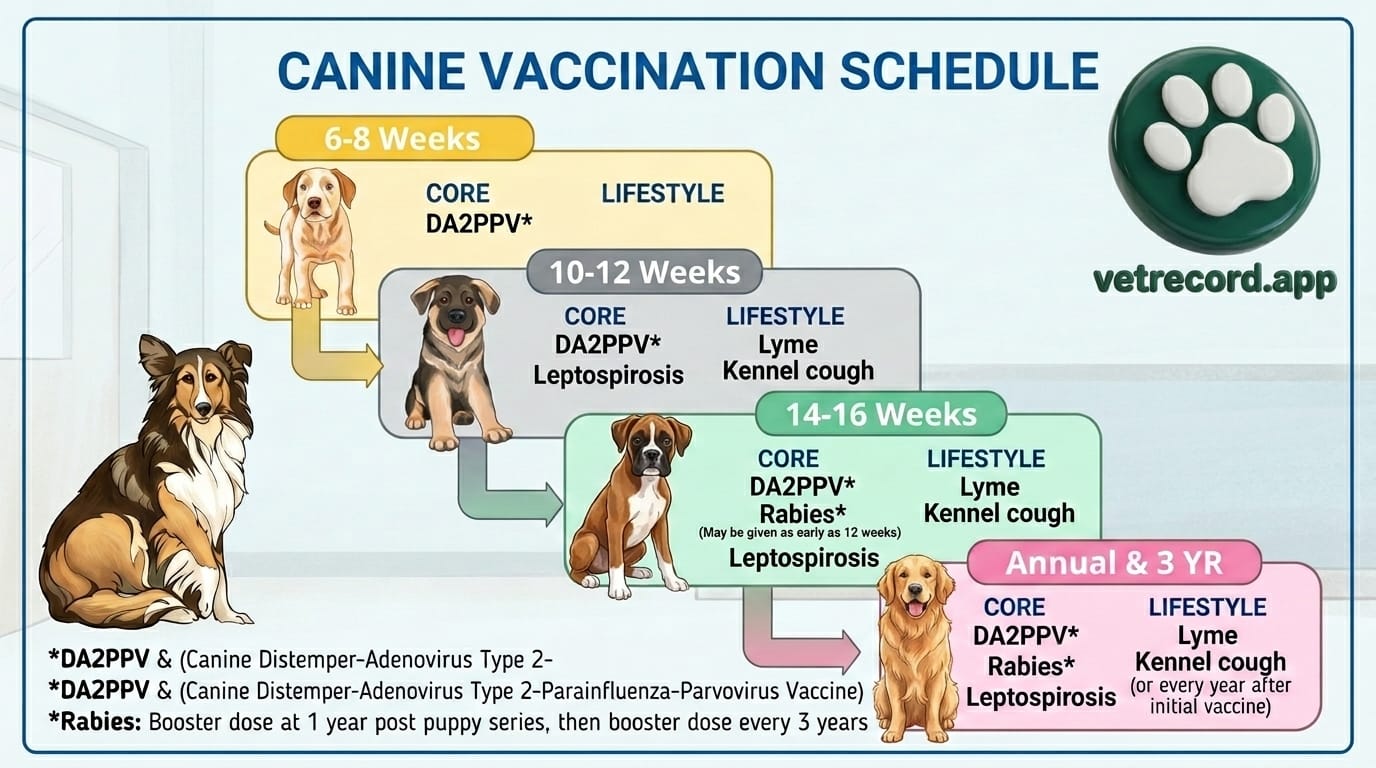
One of the first things a new dog owner encounters at the veterinary clinic is the concept of a dog vaccination schedule. This is not an arbitrary calendar — it is built around the biological reality of how a puppy's immune system matures. Puppies are born with some passive immunity transferred from their mothers through the first milk, but this borrowed protection fades between six and sixteen weeks of age. While it persists, maternal antibodies can actually interfere with a vaccine's ability to stimulate the puppy's own immune response, which is why a series of shots is given rather than a single early dose. The initial puppy series typically begins around six to eight weeks of age and continues with boosters every three to four weeks until approximately sixteen weeks. After that, the schedule transitions into adult maintenance, with some vaccines requiring annual boosters and others approved for use every three years. The American Animal Hospital Association publishes regularly updated canine vaccination guidelines that form the foundation of what most veterinarians in the United States recommend.
The Rabies Vaccine
The rabies vaccine is the single most legally significant vaccine in canine medicine. It is the only dog vaccine that is mandated by law across all fifty states in the United States, and for good reason. Rabies is a viral disease that attacks the central nervous system of all mammals, humans included, and it is almost universally fatal once clinical symptoms appear. The virus spreads through saliva, typically via a bite wound, and travels slowly through the nervous system toward the brain. The incubation period can last anywhere from a few weeks to several months, which means an infected animal may be contagious before it shows any outward signs of illness. In the United States, wildlife species like bats, raccoons, skunks, and foxes are the primary natural reservoirs of the virus, and an unvaccinated dog that encounters infected wildlife becomes a potential vector between that wildlife reservoir and the humans and pets in its household. The Centers for Disease Control and Prevention notes that human deaths from rabies in the United States are rare today largely because of sustained pet vaccination programs, but globally tens of thousands of people still die from the disease each year, the vast majority in Africa and Asia where dog vaccination coverage remains inadequate.
The rabies vaccine is typically first administered between twelve and sixteen weeks of age, with a booster required one year later. After that, depending on the vaccine formulation and the laws of the specific state and municipality, subsequent doses are required either annually or every three years. Failing to keep this vaccine current carries real legal consequences — an unvaccinated dog that bites someone may be subject to mandatory quarantine or euthanasia for testing, and the owner may face significant legal liability.
The Canine Distemper Vaccine
Canine distemper is a disease that older veterinarians remember with a kind of grim respect, because before the vaccine became widely available it was one of the leading causes of death in domestic dogs. The distemper virus attacks multiple body systems simultaneously — the respiratory tract, the gastrointestinal system, and eventually the nervous system. A dog with distemper may begin with what looks like a severe cold: runny nose, watery eyes, coughing, and fever. As the disease progresses, it can cause vomiting, diarrhea, seizures, paralysis, and death. There is no specific antiviral treatment available — veterinary care is supportive, managing symptoms while the immune system fights — and even dogs that survive may be left with permanent neurological damage, including recurring seizures, for the rest of their lives. The vaccine against canine distemper is extraordinarily effective and has dramatically reduced the prevalence of the disease in vaccinated populations. It is delivered as part of a combination shot and is considered a core vaccine by every major veterinary organization because the disease it prevents is so serious and so prevalent in unvaccinated communities.
The Canine Parvovirus Vaccine
Canine parvovirus is one of the most feared diseases in dog breeding and shelter environments, and for understandable reasons. The virus is extraordinarily resilient — it can survive on contaminated surfaces, soil, or clothing for months, and it resists many common disinfectants. It spreads through contact with infected feces, and because the infectious dose is very small, exposure can happen with minimal direct contact. Once inside a dog's body, the virus attacks rapidly dividing cells, particularly those lining the intestinal tract and those in the bone marrow, producing severe and often bloody diarrhea, vomiting, extreme lethargy, and immune system collapse. In puppies under six months of age, the mortality rate without aggressive veterinary treatment can exceed fifty percent. Even with intensive supportive care — intravenous fluids, antibiotics to prevent secondary infection, anti-nausea medication — not all dogs survive.
The canine parvovirus vaccine is one of the great success stories in veterinary medicine. It is highly effective and included in every core vaccination protocol precisely because the disease is so contagious and so deadly. Outbreaks of parvovirus today occur almost exclusively in under-vaccinated populations — unvaccinated strays, puppies whose vaccine series was incomplete, or dogs in communities where vaccination rates have dropped. The vaccine works, and its effectiveness is most visible in the stark contrast between vaccinated and unvaccinated populations when an outbreak occurs.
The Canine Adenovirus Vaccine
The canine adenovirus type 2 vaccine provides protection against both adenovirus type 1 and type 2. Adenovirus type 1 causes infectious canine hepatitis, a disease that attacks the liver and can range in severity from mild illness to rapid death. Dogs with severe infectious hepatitis may develop abdominal pain, jaundice, hemorrhage, and die within days. Adenovirus type 2 is one of several pathogens contributing to kennel cough — the infectious respiratory complex that spreads easily wherever dogs congregate. The type 2 vaccine provides cross-protection against type 1 while causing fewer side effects than the older type 1 vaccine, making it the standard choice in modern formulations. Infectious canine hepatitis is considerably less common today than it was before widespread vaccination, which has led some owners to underestimate its seriousness — but the disease has not disappeared, and the consequences of infection in an unvaccinated dog remain severe.
The Leptospirosis Vaccine
Leptospirosis is one of the most important non-core vaccines in modern veterinary practice, and its recommended use has expanded significantly as veterinarians have come to understand how widespread the disease actually is. It is caused by a spirochete bacterium called Leptospira, carried and shed in the urine of a wide range of wildlife species — rats, raccoons, deer, opossums, and many others. The bacteria survive in moist environments and contaminate soil, puddles, ponds, and standing water. A dog becomes infected through direct contact with infected urine or by swimming through or drinking contaminated water. The disease attacks the kidneys and liver, and in severe cases causes acute organ failure, internal bleeding, and death. Crucially, leptospirosis is zoonotic — humans can contract it from infected dogs, and dogs can catch it from the same environmental sources that occasionally infect people. The Cornell University College of Veterinary Medicine maintains detailed resources on the disease and its growing prevalence.
Historically considered a vaccine primarily for rural or hunting dogs, leptospirosis vaccination is now recommended much more broadly because urban wildlife — particularly rats and raccoons — has brought the bacteria into parks, backyards, and city streets where dogs regularly encounter it. Dogs that walk through wet grass, drink from puddles, or live in areas with significant rodent populations are all at meaningful risk. The leptospirosis vaccine requires two initial doses given three to four weeks apart, followed by annual boosters, because immunity from this particular vaccine does not last as long as immunity from core vaccines.
The Vaccine That Could Extend Your Dog's Life – Are We Entering a New Era?
The Bordetella (Kennel Cough) Vaccine
Kennel cough — properly called infectious tracheobronchitis — is a respiratory syndrome caused by a combination of pathogens, with Bordetella bronchiseptica serving as the primary bacterial culprit and the target of the Bordetella vaccine. The illness produces a harsh, honking cough that spreads through airborne droplets and contaminated surfaces, making any environment where dogs are in close proximity a potential transmission setting. In most healthy adult dogs, kennel cough is an unpleasant but manageable illness that resolves within one to three weeks. In puppies, elderly dogs, or immunocompromised animals, however, it can progress to pneumonia and become genuinely life-threatening.
The Bordetella vaccine is classified as a non-core vaccine by major veterinary guidelines, but in practice it functions as a requirement for any dog that spends time in boarding facilities, grooming salons, training classes, or dog parks. The American Kennel Club notes that most reputable boarding and daycare facilities require proof of current Bordetella vaccination before accepting a dog. The vaccine is available in injectable, intranasal, and oral forms, and a veterinarian can help determine which format and schedule best suits a particular dog's lifestyle and exposure level.
The Lyme Disease Vaccine
Lyme disease has become one of the most discussed tick-borne illnesses in North America, and the canine Lyme vaccine offers meaningful protection for dogs in endemic regions. The disease is caused by the bacterium Borrelia burgdorferi, transmitted through the bite of infected black-legged ticks. In dogs, Lyme disease causes lameness, joint swelling, fever, and lethargy. A particularly serious complication known as Lyme nephritis — a form of kidney disease triggered by the immune response to the infection — can be fatal and occurs more frequently in certain breeds, including Labrador Retrievers and Golden Retrievers.
The geographic range of the deer tick has expanded considerably over the past two decades, and regions across the northeastern United States, the upper Midwest, and parts of the Pacific Coast are now considered highly endemic. For dogs in these areas that spend time in wooded or grassy environments, the Lyme vaccine adds a meaningful layer of protection on top of tick prevention medications. It is not a substitute for tick control — no vaccine prevents tick attachment — but it significantly reduces the risk that an attached tick will cause disease. The vaccine requires two initial doses given two to four weeks apart, followed by annual boosters.
Stay on top of your pet’s health. 🐾
Get timely reminders for upcoming vaccinations with Vet Record.
The Canine Influenza Vaccine
Canine influenza is a relatively newer concern in veterinary medicine, first identified in dogs in the United States in the early 2000s. Two strains currently circulate in North America — H3N8 and H3N2 — and the available bivalent vaccine protects against both. Canine influenza spreads through respiratory secretions and contaminated surfaces and causes symptoms ranging from mild coughing and nasal discharge to severe pneumonia requiring hospitalization. Unlike human flu, canine influenza does not follow a predictable seasonal pattern and can occur at any time of year in environments where dogs are in close contact.
The canine influenza vaccine is a non-core vaccine recommended primarily for dogs with high social exposure — those that frequently use boarding facilities, attend dog shows, visit dog parks, or spend time in any setting where dogs congregate, particularly in geographic areas where the virus is known to be actively circulating. Like leptospirosis and Bordetella, it requires two initial doses followed by annual boosters, and a veterinarian with knowledge of local disease activity is the right person to consult about whether the vaccine is warranted for a specific dog.
A Global Perspective on Dog Vaccination
The structured vaccination programs that protect dogs and people in the United States represent a level of veterinary infrastructure that much of the world is still working to build. The World Health Organization reports that domestic dogs are responsible for approximately 99 percent of human rabies deaths globally, and the WHO has committed to a target of eliminating dog-mediated human rabies by 2030. Achieving that goal depends on reaching adequate vaccination coverage in dog populations across sub-Saharan Africa, South and Southeast Asia, and parts of Latin America — regions where free-roaming community dogs vastly outnumber available veterinary resources. Mass vaccination campaigns in these regions have demonstrated that when sustained coverage is achieved, human rabies deaths fall dramatically.
In the European Union, dogs traveling between member states or entering from outside the EU must carry a valid pet passport documenting current rabies vaccination. Australia and New Zealand maintain rabies-free status through strict quarantine and import regulations designed to prevent the virus from entering. The World Small Animal Veterinary Association has published global vaccination guidelines adaptable to widely varying resource contexts, establishing the core vaccines — rabies above all — as the non-negotiable foundation of canine preventive care in any setting worldwide.
The Right Foundation for a Healthy Life
Understanding each vaccine individually is valuable, but the decisions about which vaccines are right for a specific dog in a specific place ultimately belong to the ongoing conversation between a pet owner and their veterinarian. Non-core vaccines in particular require individualized assessment — the right protocol for a hunting dog in rural Wisconsin is not the same as the right protocol for a small dog in a city apartment. Keeping accurate vaccination records, staying current with legally required vaccines, and scheduling regular veterinary visits creates a foundation of preventive care that serves every dog well throughout its entire life.

